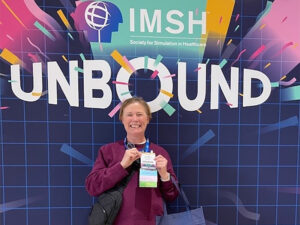
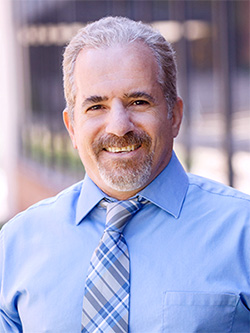
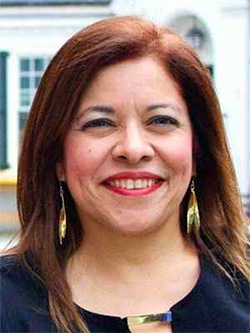
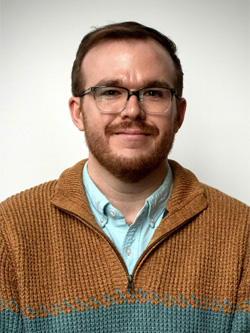
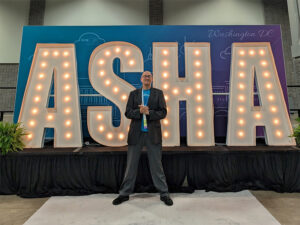
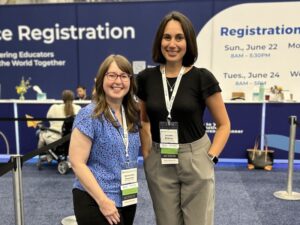
Dr. Dean Elledge, Program Director, Specialist Prosthodontist, and Amanda Conner, AEGD academic program manager in Advanced Education in General Dentistry, presented “Icebreaking and Teambuilding: Engaging Oral Health in Social Exclusion and Discrimination” at the 2024 ADEA Diversity, Equity, Inclusion and Belonging Workshop on Oct. 23, 2025.

Abstract: The ADEA Diversity, Equity, Inclusion and Belonging (ADEA DEIB) Workshop, Equity in Action: Dismantling Injustice and Promoting Social Justice in Academic Dentistry on Oct. 23 in Coronado, CA. The workshop will focus on enhancing cultural competency, identifying and dismantling systemic barriers, and developing leadership skills for advocacy.

Samantha Corcoran and Janelle Birkner at the ASEE national conference

Samantha Corcoran, associate educator, and Janelle Birkner, assistant educator, in the Department of Applied Engineering within the College of Engineering presented “A Multi-tiered Strategy to Increase Freshman Retention” at American Society of Engineering Education (ASEE) national conference in Canada on June 25, 2025.

Description: Two faculty members from the Department of Applied Engineering within the College of Engineering, Samantha Corcoran (associate educator) and Janelle Birkner (assistant educator), attended the American Society of Engineering Education (ASEE) national conference in Canada. On June 25, 2025, they presented one of two academic papers, “A Multi-tiered Strategy to Increase Freshman Retention,” which is related to the outstanding work they have done to increase freshman retention in the college through the innovative Shocker Design Experience (SDX) program.

Trevor Nelson

Trevor R. Nelson, assistant professor of musicology in the School of Music, presented “Staging Inclusion: Commonwealth Ideals in the Mid-Twentieth Century British Children’s Opera” at Music, Diplomacy, Propaganda: Towards New Directions (international conference hosted by the Université de Montréal) on Oct. 18, 2025.

Description: In Commonwealth studies, much attention is paid to Britain’s diplomatic efforts promoting the Commonwealth as the Empire’s nonhostile successor (Murphy 2018, Prior 2019). Domestically, the British government buoyed attempts to promote Commonwealth belonging particularly among young people by sponsoring children’s media espousing Commonwealth values. In exactly what ways were these values communicated, and was this propaganda effective? Drawing on Timberlake’s theories of children’s opera as political education (2015), I analyze select scenes from Britten’s Let’s Make an Opera! (1949) and Bush’s The Spell Unbound (1953). I argue that divergent understandings of Commonwealth citizenship led young performers and audiences to reject these works’ political overtones. By attending to the political ramifications of children’s operas, music scholars come to a better understanding of how music worked as a tool in shaping post-imperial Britishness.

Rhonda Williams

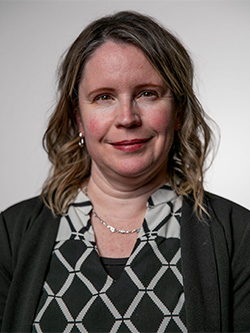
Rhonda Williams, RN-BSN, program coordinator and teaching professor in the Ascension Via Christi – Wichita State University School of Nursing, presented “Empowering RN to Baccalaureate Faculty: Strategies for Implementing the 2021 AACN Essentials” at the National League for Nursing – Educate Conference on Sept. 18, 2025.

Robert C. Manske, professor in the Department of Physical Therapy, presented “Blood Flow Restriction Training for the Upper Extremities” at ASSET Annual Meeting 2025, San Diego, California on Oct. 16, 2025.

Description: Dr. Manske presented an in depth look at the use of blood flow restriction training in the upper extremities. BFR has been used mainly in the lower extremities and has recently been used more in the upper extremities. His presentation included findings from a student research project from the Department of Physical Therapy.

Trevor Nelson

Trevor R. Nelson, assistant professor of musicology in the School of Music, presented “So Long, Farewell: The Musical Politics of Westminster Abbey Independence Services, 1962–1966” at American Musicological Society National Conference in Minneapolis on Nov. 8, 2025.

Description: Spectacle and ceremony are well-understood tools of the British Empire, overwhelming the senses of spectator-participants and enculturating them into a particular worldview. Such scholars as Wendy Webster (2005), Nalini Ghuman (2014), and Sarah Kirby (2022) have analyzed how British colonial forces used music, spectacle, and ceremony to shape understandings of imperial order across the late-nineteenth and early-twentieth centuries, in both the metropole and the colonies. Furthermore, historians have noted ceremonies as key tools in crafting a post-colonial identity across the former British empire (Cannadine 2008, Kaul 2008, Kahn 2008). But what role did these ceremonies play in shaping the people of Britain’s national consciousness during the anticolonial moment of the 1960s?

I answer this question by analyzing music used to mark the independence of British colonies at ceremonial events in London across the 1960s. Using Katie Day Good’s framework for understanding spectacle as a pedagogical tool (2020), I focus on a series of ceremonies hosted by Westminster Abbey, intended to welcome former colonies as independent members of the British Commonwealth. Planned by the Abbey and the British Government’s Colonial Office, these spectacular events took the form of Anglican worship services and featured musical well-wishes to these independent nations. These pieces included hymns and instrumental works that would not feel out of place in the Abbey’s hallowed halls, leading to the ceremonies having a uniform sound, one distinctly British in nature, rather than idiosyncratic approaches highlighting the unique musical qualities of the varying nations. Drawing on materials from the British National Archives and the Westminster Abbey Archives, I reconstruct the questions and debates leading up to the ceremonies for Jamaica (1962), Kenya (1963), and Guyana (1966). I argue that, through music, one hears how the British Government’s desire to control and shape the Commonwealth in their national image led programmers to structure these events to please British attendees, rather than the newly independent nations they were supposedly honoring. By reframing spectacle from this vantage point, this project highlights how music can both support and undermine the crafting of national identity via ceremony.

Andrew Myers, director of scholarships and student services – Dorothy and Bill Cohen Honors College presented “We are all talking gibberish: Communicating with Gen Z Through the Advising Process” at 2025 Kansas Academic Advising Network annual conference Sept. 19, 2025.

Description: Andrew Myers, Director of Scholarships and Student Services in the Dorothy and Bill Cohen Honors College, presented a paper for the Kansas Academic Advising Network (KAAN) annual conference held at Fort Hays State University on Sept. 19. His interactive presentation titled “We are all talking gibberish: Communicating with Gen Z Through the Advising Process” is based on a recent exploratory study of preferred communication among Generation Z students. It invited attendees to evaluate their communication methods and develop ideas for more effective communication. The Kansas Academic Advising Network supports academic advisors through the state of Kansas and serves as a communication network among institutions of higher education for the development of the academic advising profession.

Andrew Myers, director of scholarships and student services in the Dorothy and Bill Cohen Honors College, presented “We are all talking gibberish: Communicating with Gen Z Through the Advising Process” at 2025 Kansas Academic Advising Network annual conference Sept. 19.

Description: Andrew Myers, Director of Scholarships and Student Services in the Dorothy and Bill Cohen Honors College, presented a paper for the Kansas Academic Advising Network (KAAN) annual conference held at Fort Hays State University on Sept. 19. His interactive presentation titled “We are all talking gibberish: Communicating with Gen Z Through the Advising Process” is based on a recent exploratory study of preferred communication among Generation Z students. It invited attendees to evaluate their communication methods and develop ideas for more effective communication. The Kansas Academic Advising Network supports academic advisors through the state of Kansas and serves as a communication network among institutions of higher education for the development of the academic advising profession.

Alyssa Lynne-Joseph, assistant professor in the Department of Sociology, presented “Between the Local and the Global: Clinical Practice Guidelines for Gender-Affirming Care” at Society for the Social Studies of Science (4S) on Sept. 6, 2025.

Description: Dr. Lynne-Joseph presented her research on the process of creating a set of Thai-specific clinical practice guidelines as part of a panel titled “Revisiting Biomedicalization: Toward a Technology-Focused Approach.” The panel considered how the use of different tools and technologies in medicine transforms our social understanding of health and illness. Her research found that even as clinicians, patients, and activists sought to create a set of guidelines they envisioned as “local,” they simultaneously grappled with the possible reverberations of these guidelines in the global sphere, revealing the close intertwining of these geographic scales.

Jennifer Thornberry, DNP, APRN, FNP-BC, assistant professor in the Ascension Via Christi – Wichita State University School of Nursing, presented “Development of a Standardized Patient Education Program” at Kansas Nurse Educator Conference at Newman University July 17.

Description: In this presentation, the experiences of utilizing the Association of Standardized Patient Educators (ASPE) Standards of Best Practice (SOBP) in the development of a standardized patient education program were described so that other nursing education programs can develop or evaluate their own standardized patient simulation programs. Results from a qualitative study about high stakes standardized patient exams for FNP students were presented with a goal of understanding the student nurse experience in high stakes SP exams.