The Department of Biological Sciences’ fall 2023 seminar series begins Monday, Aug. 28, with its newest staff member Evalynn Trumbo with her talk, “Migrating from the Ozarks to the Plains: Birds, bats and bugs.”

The seminar is held from 4 to 5 p.m. in 218 Hubbard Hall. Seminars are open to the public and undergraduates are encouraged to attend.

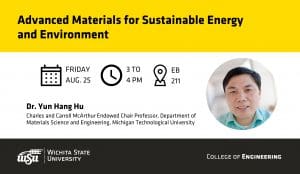
"Advanced Materials for Sustainable Energy and Environment" | Friday, August 25 | 3 to 4 pm | EB, 211 | Dr. Yun Hang Hu, the Charles and Carroll McArthur Endowed Chair Professor, Department of Materials Science and Engineering, Michigan Technological University

The Department of Mechanical Engineering within the College of Engineering is hosting Dr. Yun Hang Hu, the Charles and Carroll McArthur Endowed Chair Professor from the Department of Materials Science and Engineering at Michigan Technological University.

Hu will present “Advanced Materials for Sustainable Energy and Environment” to students, staff, faculty and industry partners from 3 to 4 p.m. Friday, Aug. 25 in 211 Engineering Building.

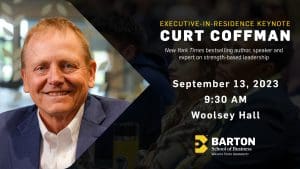
Executive in Residence Keynote - Curt Coffman. New York Times bestselling author, speaker and expert on strength-based leadership. September 13, 2023 at 9:30 AM in Woolsey Hall.

The Barton School of Business has announced Curt Coffman as its fall 2023 Executive-in-Residence. Coffman is the founder of The Coffman Organization and co-author of New York Times bestsellers, “First Break All the Rules: What the World’s Greatest Managers Do Differently” and “Culture Eats Strategy for Lunch.”

As Executive-in-Residence, Coffman will provide mentorship opportunities to students, exchange ideas with Barton School faculty and staff, and host a conversation with industry leaders. The theme of his residency and title of his keynote presentation is “The Power of You: New Formula for Growth.” Following the keynote, Coffman will distribute and sign two of his books to those in attendance.

RSVP for the keynote, 9:30-10:30 a.m. Wednesday, Sept. 13 in Woolsey Hall, at no additional charge.

Former President Richard Nixon giving a speech on a 1960s-era television

Join the Ulrich Museum of Art for a talk from Dr. Ajita Rattani, “Deepfake Detection: Challenges and Future Research Directions,” starting at 6 p.m. Thursday, July 13 in the Beren Gallery at the Ulrich and via livestream. Attendees are also invited to a reception at 5:30 p.m.

Rattani is the director of WSU’s Visual Computing and Biometric Security Lab. She will discuss the use of deep fakes to commit fraud, falsify evidence, manipulate public debates and destabilize political processes and the attempts to mitigate the risk.

The talk is part of the larger exhibition, In Event of Moon Disaster, a multi-media project created by directors Halsey Burgund and Francesca Panetta to illustrate the possibilities of deepfake technologies. They also offer a variety of resources to help the public understand and recognize the technologies involved.

The public events accompanying the exhibition are supported by the College of Engineering, Fairmount College, National Institute for Aviation Research (NIAR) and the Barton School.

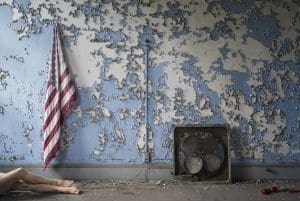
A wall with peeling blue paint, an American flag, a red phone and a women's pair of legs.

The Ulrich Museum will host the talk, “Susan Copich’s Mediated Femininities: One Body, Many Stories,” with artist Susan Copich at 6 p.m. Thursday, June 29 in the Polk/Wilson Gallery in the Ulrich, with a Q&A segment following the talk. A reception will be held starting at 5:30 p.m.

Susan will choose a selection of her images and explore the underlying intentions behind each photograph. She will delve into the technical, metaphorical and psychological layers that make up each image and share her inspirations for each of her series and the creative decisions she made during the process. Additionally, she will touch on the subconscious overarching themes that reveal themselves over time and through perspective.

Headshot of Dr. Omar Sediek

Dr. Omar Sediek will speak as part of the Disaster Resilience Analytics Center (DRAC) seminar series from noon to 1 p.m. Thursday, June 22 via Zoom.

His talk will discuss the necessity of distributed computing for conducting cross-disciplinary research where field-specific computational models (simulators) are available, but have not been designed to work together. An example of this is natural hazards research. Simulators abound in the disparate fields that fall under this area (e.g. social science, engineering, economics and health), but little progress has been made to integrate the simulators to study overarching and cross-disciplinary disaster scenarios. The reason for slow penetration of this technology is the high barrier to entry, which requires extensive knowledge of computer science and programming. The talk will focus on a platform named Simple Run Time Infrastructure (SRTI) that address the issues mentioned above. Designed to provide a low barrier to use, SRTI v2 is developed for users with limited programming experience and designed to simplify and streamline a user’s effort to compose a distributed simulation and handle time management.

Dr. Sediek is a bridge engineer at Alfred Benesch & Company. He received his joint Ph.D. in civil engineering and scientific computing from the University of Michigan in Ann Arbor with specialization in seismic resilience of communities. He received his bachelor’s and master’s from Cairo University in Egypt. His research interests span from the stability of steel members to community resilience against natural hazards and the use of artificial intelligence in structural engineering.

Jan Dirk Roggenkamp, professor of public law at the Berlin School of Economics and Law, will present “The German Model of Police Education” at 3:30 p.m., Thursday, June 22, in 265 Rhatigan Student Center. A reception will follow.

Roggenkamp researches IT law, in particular the legal implications of police work and information technology (e.g., data retention, monitoring and surveillance of IT, use of social networks, data protection and privacy). He has published numerous articles in German law journals. He is also the author/editor of legal commentaries on data protection law, internet law, police law and association law.

A photo of a face is split into two sides: one is the face of an actor. The other is the face of Richard Nixon.

Join the Ulrich Museum of Art for a talk from Joshua Saxe, “The Promise and Peril of Intelligent, Creative Machines,” starting at 6 p.m. Thursday, June 15 in the Beren Gallery at the Ulrich and via livestream. Attendees are also invited to a reception at 5:30 p.m.

Saxe is a Wichita-based computer scientist and a senior staff AI scientist at Meta, where he helps lead the design and implementation of trust and safety measures using generative AI. Prior to working at Meta, he was chief scientist at Sophos and principal investigator on multiple DARPA-funded cybersecurity AI research programs.

The talk is part of the larger exhibition, In Event of Moon Disaster, a multi-media project created by directors Halsey Burgund and Francesca Panetta to illustrate the possibilities of deepfake technologies. They also offer a variety of resources to help the public understand and recognize the technologies involved.

The public events accompanying the exhibition are supported by the College of Engineering, Fairmount College, National Institute for Aviation Research (NIAR) and the Barton School.
An actor reads a script for a director in a recording studio.

Join the Ulrich Museum of Art for a talk from Halsey Burgund, “How to Strand Astronauts on the Moon (and other artistic uses for AI),” starting at 6 p.m. Thursday, June 8 in the Beren Gallery at the Ulrich and via livestream. Attendees are also invited to a reception at 5:30 p.m.

Burgund is a new media artist and Emmy-winning interactive director whose work focuses on the combination of modern technologies — from mobile phones to artificial intelligence — with fundamentally human “technologies,” primarily language, music and the spoken voice.

The talk is part of the larger exhibition, In Event of Moon Disaster, a multi-media project created by directors Burgund and Francesca Panetta to illustrate the possibilities of deepfake technologies. They also offer a variety of resources to help the public understand and recognize the technologies involved.

The public events accompanying the exhibition are supported by the College of Engineering, Fairmount College, National Institute for Aviation Research (NIAR) and the Barton School.

A photo of Yelena Filipchuk and Serge Beaulieu, from the art collective HYBYCOZO, standing in front of a many-sided, brass, geometric sculpture.

The Ulrich Museum of Art will host an artist talk with HYBYCOZO, a collaborative installation art collective made up of Serge Beaulieu and Yelena Filipchuk at 6 p.m. Thursday, June 1 in Woolsey Hall. Their sculpture, Stratosphere, was the most recent piece to join the Martin H. Bush Outdoor Sculpture Collection in fall 2022. A reception is scheduled for 5:30 p.m.

HYBYCOZO’s work consists of larger-than-life sculptures that celebrate the inherent beauty of geometric form and pattern, and compose them in ways that harmonize the experience of sculpture, light and shadow. Much of their work draws on inspirations from mathematics, science and patterns in nature and acknowledges diverse cultural influences in pattern making and design. They seek to create public art that creates a sense of place and invites wonder and curiosity, not only about the elemental geometric forms used to compose their sculptures, but also in the technological processes used to create them.