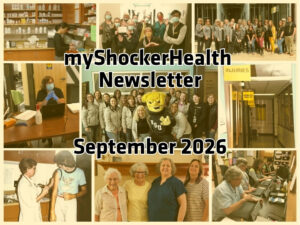
Check out issue 16 of the myShockerhealth newsletter. Monthly, the Student Health newsletter provides relevant health information and wellness tips for WSU students and staff.

For this issue, learn more about:

  • Student Employee Appreciation Week
  • When to take your vitamins
  • Health and wellness of native communities
  • Stress Awareness Month
  • Understanding GLP-1 medications
  • Have you heard of hands only CPR?
  • Respiratory viruses season

You can find all previous issues on the Student Health website.

This is a picture of the WSU privacy logo with a black fingerprint embedded with wheat shocks on a gold background. The words Wichita State University and the contact information for the privacy office is listed on it which is 316-978-4HIP and hipaaprivacy@wichita.edu.

At the heart of the mission as a higher education institution is trust — trust from students, faculty, staff, alumni, and research partners. That trust depends on how responsibly personal information is handled. One of the most effective ways to protect privacy while supporting academic and operational excellence is through data minimization.

Data minimization means intentionally limiting the personal data collected, used, stored and shared to what is directly relevant and necessary to fulfill a legitimate institutional purpose. Rather than asking, “What data could we collect?”, instead ask, “What data do we truly need — and for how long?”

Why data minimization matters

In a university environment, vast and diverse data sets are managed — student records, employee information, learning analytics, research data, health information and digital activity logs. While this information supports teaching, research and operations, unnecessary or excessive personal information collection increases risk without increasing value.

Practicing data minimization:

  • Reduces privacy and security risk by limiting exposure in the event of a data breach or misuse.
  • Supports regulatory and contractual obligations, including FERPA, HIPAA, GDPR (where applicable) and state privacy laws.
  • Strengthens institutional trust by demonstrating respect for individual privacy and autonomy.
  • Improves data quality and governance by focusing attention on accurate, relevant and purposeful information.

Simply put, the less sensitive personal information held without a clear need, the better positioned the university is to protect the community.

What data minimization looks like in practice

Data minimization is not about limiting innovation or academic freedom; it is about disciplined, intentional data practices. Across the institution, this means:

  • Purpose-driven collection: Clearly defining why personal information is needed before collecting it, especially in surveys, digital tools, learning technologies and research support platforms.
  • Least-necessary use: Ensuring access to personal information is limited to individuals and units with a legitimate role.
  • Retention with intent: Keeping personal information only as long as required by policy, law or documented business need — and securely disposing of it when no longer needed.
  • Third-party accountability: Evaluating vendors and partners to ensure they align with our data minimization and privacy expectations.

Everyone has a role

Data minimization is not solely an IT or compliance obligation — it is a shared institutional responsibility.

  • Faculty and researchers should consider whether identifiable personal data elements are essential to their academic or research goals.
  • Staff and administrators should review forms, systems and processes and work with data owners and stewards to determine what personal information can be kept and what could be redacted.
  • Leadership should model privacy-conscious decision-making and support governance structures that embed minimization into procurement, system design and policy.

By integrating data minimization into everyday decisions, everyone strengthens both privacy and operational resilience.

Moving forward

The commitment to data minimization reflects broader values: stewardship, accountability and respect for the individuals who entrust WSU with their information. As technologies evolve and data use becomes more complex, minimizing what is collected and retained is one of the most practical and impactful ways to uphold privacy.

Together, by collecting less, managing smarter and retaining only what is necessary, everyone protects the community and reinforce trust in the institution today and for the future.

For more information and resources on data minimization as it relates to privacy, visit WSU Privacy Website Information – Home. For more information on how to contact the Privacy Office or report a privacy concern, check out the Privacy Office website.

CourseLeaf will have a fresh look soon as WSU moves to a new version that introduces a user dashboard. Visit wichita.edu/courseleaf for easy instructions on how to navigate the dashboard.

The new CourseLeaf dashboard provides:

  • Access to CIM, CLSS, CAT, Workflow and user guides from one screen
  • A more personalized user experience
  • Easy-to-use filtering and sorting options
  • A visual thermometer to sort your proposals by status
  • A new layout for the “Approve Pages” screen
  • Improved accessibility
  • A better experience on small screens
Collage of hospitality industry related fields with the word Hospitality overlayed.

The Barton School of Business has launched its Hospitality Advisory Board, bringing together accomplished leaders from across the industry to help shape and elevate its undergraduate hospitality program and build a strong talent pipeline.

Chaired by Nikki Beyrle, Hospitality Executive-in-Residence and chief human resources officer at LDF Companies, the board represents a strategic step in advancing the Barton School’s vision through industry insight, mentorship and applied learning opportunities.

Applications are currently open for the 2026-27 First-Generation Fellows. The First-Generation Fellows support SEM Goal 3 to “Increase persistence rates of degree seeking student populations.” Each First-Generation Fellow leads a working group of the F1RST Generation Coordinating Council.

Applications are due by the end of May 8. For questions or more information, contact Brett Petersen-Bruner, associate vice provost for Student Success & Persistence, at brett.bruner@wichita.edu.

The spring semester is coming to an end, and final exams are just around the corner. Faculty and GTAs, complete and submit a “Test Information Form” (TIF) so the Office of Student Accommodations and Testing can enter the details into RegisterBlast and students can begin scheduling their final exam appointments.

If your final exam is not yet ready to upload, still submit the form. OSAT can collect the exam from you once it is prepared. You may email testingcenter@wichita.edu with any questions and to share additional information.

The Service-Learning Showcase is a unique opportunity for students who participate in service-learning through applied learning opportunities to showcase their experience through a research or reflective poster about the application of their course work to current community issues.

The showcase is an open forum for students to interact with faculty/staff, community partners and other students to engage in conversation about Wichita State’s commitment to the public good. This year, 15 individual and group projects participated, supporting 26 community partners, and representing four academic colleges (College of Engineering, Dorothy and Bill Cohen Honors College, Fairmount College of Liberal Arts & Sciences, and College of Health Professions). Thanks to all the students, faculty and community partners that are working together to ensure Wichita State is supporting the greater public good.

Awards were presented in the following categories:

Overall Service-Learning Award:

  • Title: Service-Learning at BILL’S Trip
  • Community partner: Hot Springs National Park, Little Rock HS National Monument, Lake Catherine State Park
  • Students: Olive Colfelt, Bentley Hagerman, Claire Stewart, Elijah Allen, Lorena Favela, Harper Wright, Jenna Moore-Kirby, Karaline Scott and Layton Maienschein
  • Faculty: Dr. Chelsea Redger-Marquardt, Cohen Honors College + College of Education, Olivia Cutler, College of Education

Community Impact in Service-Learning Award:

  • Title: A Work Systems Study with Dear Neighbor Ministries
  • Community partner: Dear Neighbor Ministries
  • Student: Cody Goetz, Daniel Gonzalez, Tanatswa Mafume
  • Faculty: Dr. Laila Cure, College of Engineering

Innovation, Creativity, & Advocacy in Service-Learning Award:

  • Title: Los Pollitos​ Service-Learning Showcase
  • Community partner: Wichita State University Child Development Center
  • Student: Lydia Scheck, Kimberly Rader, Cary Doerflinger
  • Graduate student: Daniela Yañez Zuazo
  • Faculty: Dr. Rocio Del Aguila & Dr. Maria Hernandez-Etura, Fairmount College of Liberal Arts & Sciences 

Collaboration and Leadership in Service-Learning Award:

  • Title: Donation Warehouse Process Improvement
  • Community partner: Union Rescue Mission
  • Students: Devin Taylor, Logan Erion, Domanic Wood, Esteban Ruiz
  • Faculty: Dr. Laila Cure, College of Engineering

For more information about service-learning, visit wichita.edu/servicelearning.

The Office of Student Engagement & Belonging is proud to announce that Sigma Phi Epsilon are the Hippodrome 2026 champions. Sigma Phi Epsilon won first place for its performance of “Huxley: A Five Act Stage Play” that explored themes of virality, childhood dreams and loss.

SE&B also thanks the other participants: Beta Theta Pi, Delta Gamma & Gamma Phi Beta/Sigma Alpha Epsilon & Alpha Phi/Delta Delta Delta & Delta Upsilon/Phi Delta Theta & Kappa Kappa Gamma. SE&B would also like to thank all alumni who attended the event and a special thank you to WSU Foundation and Alumni Engagement for putting on the All-Greek Reunion this past weekend.

The 2026-27 Wichita State undergraduate and graduate catalogs are now live and online. Links to both catalogs can be found at wichita.edu/catalog.

Get updated information on admission, financial aid, advising, student resources, degree requirements and more.

Use the “Search Courses” feature to find courses offered at WSU by subject, department or course attributes such as general education, badges and honors.

Look on the “Degrees and Academic Majors” page to browse through all of WSU’s undergraduate or graduate degrees, programs and certificates. The search feature allows you to narrow the table down to the programs you are most interested in. Click on the name of the program and go right to the program information.

The catalogs are accessible from your desktop, tablet and smartphone.

Links to download PDFs of the full undergraduate and graduate catalogs are located at the bottom right of every page.

Wichita State is excited to announce that the State of Kansas Applied Learning Funds are now open for applications for the fiscal year 2027.

Who can apply?

Wichita State colleges and departments are invited to submit proposals. Special attention will be given to programs that have traditionally lacked access to paid applied learning opportunities.

What are the funding priorities?

  • Areas of greatest need: Priority will be given to proposals that expand paid applied learning opportunities in fields with limited access to paid experiences and strengthen the Kansas talent pipeline.
  • Academic alignment: The work-based experience should connect with your academic program, ensuring students are building valuable bridges between theory and practice.
  • Data-driven approach: The ability to collect data on your program’s effectiveness is crucial. This helps us ensure these funds have a lasting positive impact on student success.

To submit your proposal, visit wichita.edu/ALfund.