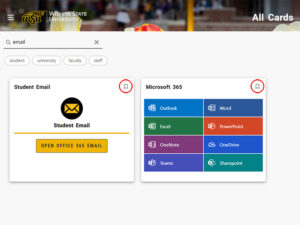
Check out the new Financial Services SharePoint site. All internal processes and procedures have been moved to this new location to make information easier to find and maintain. Take a few moments to explore the site, become familiar with the updated layout and bookmark it for quick access to your resources moving forward.

Financial Services will remove all internal processes and procedures from the Wichita State website over the next several days.

Logan Alexander and Lowell Kaufman stand next to the tree in front of Morrison Hall

President Rick Muma and First Gentleman Rick Case’s annual Christmas tree at the President’s Residence has been replanted on Wichita State’s campus in dedication to Lowell Kaufman, maintenance supervisor, and Logan Alexander, arborist, with Landscape and Ground Maintenance.

The tree, a blue atlas cedar, was dedicated in honor of Kaufman and Alexander for their joint efforts in supporting sustainability and maintaining the green spaces on campus. It now sits on the east side of Morrison Hall.

“This tree is symbolic of the care and commitment to sustainability that Lowell and Logan bring to our campus every day,” Muma said. “Their idea to replant these trees allows something momentary to become lasting, and it’s a meaningful way to honor their impact on Wichita State.”

Instead of purchasing a chopped tree that could only be used for a short amount of time, it was Kaufman and Alexander’s idea to use balled and burlap trees, which still have their roots intact and can be replanted. These trees could be used at the President’s Residence and later be repurposed for the entire campus.

The first of these trees was dedicated to former dean of students James Rhatigan, located just north of the Rhatigan Student Center, following his passing in October 2024.

With the dedication this Arbor Day comes a new yearly tradition that promotes sustainability and supports a vibrant, green campus for students, faculty, staff, partners and the community.

“What began as a holiday tradition at the President’s Residence has grown into something far bigger,” Case said. “By replanting these trees, we’re creating a living legacy that supports a greener campus and reflects Wichita State’s shared responsibility to one another and to the environment.”

Three women stand indoors holding “2026 Mentor Teacher of the Year” certificates from Wichita State University’s School of Teaching and Learning. They are smiling and posed side by side in front of a wood-paneled wall with a window and natural light to the right.

The College of Education’s School of Teaching and Learning has recognized outstanding educators with its Mentor Teacher Awards for their impact on teacher candidates and the profession.

The Mentor Teacher Award recognizes distinguished mentoring of teacher candidates and interns; strong modeling of pedagogical content knowledge; effective instructional co-planning and co-teaching grounded in research-based practices; meaningful feedback that supports candidate growth and development; participation in professional activities; and leadership in the teaching profession.

2026 Mentor Teacher Award recipients:

  • Kathleen Moddelmog, kindergarten, Linwood Elementary
  • Kristen Yacenda, first grade, Linwood Elementary
  • Kristin Wolke, third grade, Chisholm Trail Elementary
  • Hannah Kelderman, science, North High School
  • Brian Curtis, social studies, Pleasant Valley Middle School
  • Jack Doornbos, physical education, McLean Elementary
  • Heather Hansen, English, North High School

The U.S. Department of Justice has extended the federal compliance deadline for the updated Title II regulations under the Americans with Disabilities Act by one year. While this extension provides additional time at the federal level, the university remains committed to moving forward expeditiously to achieve full accessibility and compliance.

Accessibility work is ongoing and remains a shared, institution‑wide responsibility. All new public‑facing academic and non‑academic content must continue to meet applicable federal accessibility standards and existing content that is not currently accessible is being addressed through structured remediation planning.

To support units in this work, a new Title II SharePoint page has been launched. This site will serve as the central internal location for updates, expectations, guidance, resources and contact information related to the university’s Title II compliance efforts. Faculty and staff are encouraged to review the Title II SharePoint page for additional details and future updates as this work continues.

Check out issue 16 of the myShockerhealth newsletter. Monthly, the Student Health newsletter provides relevant health information and wellness tips for WSU students and staff.

For this issue, learn more about:

  • Student Employee Appreciation Week
  • When to take your vitamins
  • Health and wellness of native communities
  • Stress Awareness Month
  • Understanding GLP-1 medications
  • Have you heard of hands only CPR?
  • Respiratory viruses season

You can find all previous issues on the Student Health website.

This is a picture of the WSU privacy logo with a black fingerprint embedded with wheat shocks on a gold background. The words Wichita State University and the contact information for the privacy office is listed on it which is 316-978-4HIP and hipaaprivacy@wichita.edu.

At the heart of the mission as a higher education institution is trust — trust from students, faculty, staff, alumni, and research partners. That trust depends on how responsibly personal information is handled. One of the most effective ways to protect privacy while supporting academic and operational excellence is through data minimization.

Data minimization means intentionally limiting the personal data collected, used, stored and shared to what is directly relevant and necessary to fulfill a legitimate institutional purpose. Rather than asking, “What data could we collect?”, instead ask, “What data do we truly need — and for how long?”

Why data minimization matters

In a university environment, vast and diverse data sets are managed — student records, employee information, learning analytics, research data, health information and digital activity logs. While this information supports teaching, research and operations, unnecessary or excessive personal information collection increases risk without increasing value.

Practicing data minimization:

  • Reduces privacy and security risk by limiting exposure in the event of a data breach or misuse.
  • Supports regulatory and contractual obligations, including FERPA, HIPAA, GDPR (where applicable) and state privacy laws.
  • Strengthens institutional trust by demonstrating respect for individual privacy and autonomy.
  • Improves data quality and governance by focusing attention on accurate, relevant and purposeful information.

Simply put, the less sensitive personal information held without a clear need, the better positioned the university is to protect the community.

What data minimization looks like in practice

Data minimization is not about limiting innovation or academic freedom; it is about disciplined, intentional data practices. Across the institution, this means:

  • Purpose-driven collection: Clearly defining why personal information is needed before collecting it, especially in surveys, digital tools, learning technologies and research support platforms.
  • Least-necessary use: Ensuring access to personal information is limited to individuals and units with a legitimate role.
  • Retention with intent: Keeping personal information only as long as required by policy, law or documented business need — and securely disposing of it when no longer needed.
  • Third-party accountability: Evaluating vendors and partners to ensure they align with our data minimization and privacy expectations.

Everyone has a role

Data minimization is not solely an IT or compliance obligation — it is a shared institutional responsibility.

  • Faculty and researchers should consider whether identifiable personal data elements are essential to their academic or research goals.
  • Staff and administrators should review forms, systems and processes and work with data owners and stewards to determine what personal information can be kept and what could be redacted.
  • Leadership should model privacy-conscious decision-making and support governance structures that embed minimization into procurement, system design and policy.

By integrating data minimization into everyday decisions, everyone strengthens both privacy and operational resilience.

Moving forward

The commitment to data minimization reflects broader values: stewardship, accountability and respect for the individuals who entrust WSU with their information. As technologies evolve and data use becomes more complex, minimizing what is collected and retained is one of the most practical and impactful ways to uphold privacy.

Together, by collecting less, managing smarter and retaining only what is necessary, everyone protects the community and reinforce trust in the institution today and for the future.

For more information and resources on data minimization as it relates to privacy, visit WSU Privacy Website Information – Home. For more information on how to contact the Privacy Office or report a privacy concern, check out the Privacy Office website.

CourseLeaf will have a fresh look soon as WSU moves to a new version that introduces a user dashboard. Visit wichita.edu/courseleaf for easy instructions on how to navigate the dashboard.

The new CourseLeaf dashboard provides:

  • Access to CIM, CLSS, CAT, Workflow and user guides from one screen
  • A more personalized user experience
  • Easy-to-use filtering and sorting options
  • A visual thermometer to sort your proposals by status
  • A new layout for the “Approve Pages” screen
  • Improved accessibility
  • A better experience on small screens
Collage of hospitality industry related fields with the word Hospitality overlayed.

The Barton School of Business has launched its Hospitality Advisory Board, bringing together accomplished leaders from across the industry to help shape and elevate its undergraduate hospitality program and build a strong talent pipeline.

Chaired by Nikki Beyrle, Hospitality Executive-in-Residence and chief human resources officer at LDF Companies, the board represents a strategic step in advancing the Barton School’s vision through industry insight, mentorship and applied learning opportunities.

Applications are currently open for the 2026-27 First-Generation Fellows. The First-Generation Fellows support SEM Goal 3 to “Increase persistence rates of degree seeking student populations.” Each First-Generation Fellow leads a working group of the F1RST Generation Coordinating Council.

Applications are due by the end of May 8. For questions or more information, contact Brett Petersen-Bruner, associate vice provost for Student Success & Persistence, at brett.bruner@wichita.edu.

The spring semester is coming to an end, and final exams are just around the corner. Faculty and GTAs, complete and submit a “Test Information Form” (TIF) so the Office of Student Accommodations and Testing can enter the details into RegisterBlast and students can begin scheduling their final exam appointments.

If your final exam is not yet ready to upload, still submit the form. OSAT can collect the exam from you once it is prepared. You may email testingcenter@wichita.edu with any questions and to share additional information.