Be sure that you are prepared and weather aware as you make your way to and around campus.

  • Keep an eye on the weather. Forecasts can change suddenly. Sign up for ShockerAlert through text.
  • While traveling, whether on foot or by car, allow yourself extra time to make it to your destination safely.
  • Wear warm clothing, such as water-resistant coats and boots and several layers of clothing, and cover the most-affected body parts such as nose, ears, toes, cheeks, chin and fingers with hats, scarves and gloves.

While on campus, buildings are open during the school day, so if you feel like you are experiencing any adverse effects from the weather, take a moment to warm up in a building before continuing.

If you experience any health issues, you can contact the Faculty/Staff Acute Care Clinic in the Steve Clark YMCA on campus by calling 316-978-4792. The Faculty/Staff Acute Care Clinic can help treat minor/acute medical issues.

During periods of inclement weather, the university closely monitors weather conditions to make informed decisions about campus operations.

University leadership reviews local weather, evaluates transportation conditions, and assesses campus facilities and operations in relation to:

  • Weather forecasts and environmental conditions
  • Road and campus safety
  • Availability of essential services on campus
  • Impact on campus education and research activity, residential students, clinical and field education experience, and paid applied learning

In the event of severe weather, the university may determine that it is necessary to adjust the university’s normal operations. Notifications will be communicated one or more of the following ways: WSU email, text message, the university website, WSU social media and campus newsletters. Individual class information will be sent by instructors through Blackboard and/or may be included in course syllabi.

No decision can perfectly fit the circumstances of every member of the community. That is why the university emphasizes shared and personal responsibility. It is important to be, and stay prepared for, inclement weather throughout the school year. Examples of things you can do:

  • Dress in layers and limit time outdoors during extreme cold.
  • Stay hydrated and take frequent breaks inside air-conditioned facilities during extreme heat.
  • Know the locations of tornado shelters in case of an emergency during storm season.
  • Keep your devices charged and check your email regularly for updates.
  • Review and bookmark the university’s Weather Emergencies page for the latest information.

Keeping our community safe during severe weather

At Wichita State University, the safety and well-being of our students, faculty and staff is our top priority. During periods of inclement weather or extreme cold, we closely monitor weather conditions and make informed decisions about campus operations.

Each weather event is different, and decisions require input from many parts of the university. The university is not a single-function organization – it is a residential community, a center for research, a workplace and an academic institution all at once. Facilities staff assess whether sidewalks, parking lots and campus roadways can be cleared and maintained. Dining and housing staff evaluate whether they can continue supporting thousands of students who live on campus and rely on university services regardless of closures. Academic leaders consider the implications for classes, labs and clinical rotations, while Human Resources evaluates employee obligations and safety.

The university’s inclement weather policy may be accessed here: WSU Policy 5.17 / Inclement Weather And Emergency Event. In an effort to address frequently asked questions, here’s what you need to know:

How do we decide when adjustments to university operations are necessary?

University leadership reviews local weather, evaluates transportation conditions, and assesses campus facilities and operations in relation to:

  • Weather forecasts and environmental conditions
  • Road and campus safety
  • Availability of essential services on campus
  • Impact on campus education and research activity, residential students, clinical and field education experience, and paid applied learning

When do we adjust university operations (including moving to remote operations)?

In the event of severe weather, the university may determine that it is necessary to adjust the university’s normal operations. We consider such adjustments when:

  • Projected excessive wind chills, especially when combined with snow, ice or hazardous travel conditions.
  • Road conditions are deemed unsafe for commuting.
  • Campus infrastructure is significantly compromised by the weather (e.g., heating systems, pathways, parking lots).
  • High risk of property damaging storms

What happens if we go remote?

  • Most classes will be held online. Your instructor will notify you as to how or whether your class will be held. At certain times, staff may be called to campus in support of operations.
  • Faculty and staff will work remotely unless they hold a position that supports critical campus operations, as defined in WSU Policy 5.17 / Inclement Weather And Emergency Event.
  • Campus services such as dining, housing and childcare will remain operational. Student health will be delivered using telehealth. Hours for campus services may be adjusted. For any questions, contact information for campus services is provided below.
  • University notifications will be sent via email, text alerts and posted on the university website and social media. Individual class information will be sent out through Blackboard and/or may be included in course syllabus.

Contact information for campus services:

Shared and personal responsibility

No decision can perfectly fit the circumstances of every member of our community. That is why we emphasize shared and personal responsibility. Weather conditions can vary widely depending on where you live or the time of day you travel. Each individual must evaluate their own situation, prioritize personal safety and make responsible choices about whether it is safe to come to campus.

Freezing temperatures, in the absence of precipitation, will not likely result in the closure of campus or remote operations. Therefore, it is important to be, and stay prepared for, inclement weather. Examples of things that you should be doing:

In Kansas, thunderstorms are common in the spring and fall months, while at the same time the actual severity of storm events, and their location, are difficult to predict by even the best meteorologist. Storms can occur within very short notice and often last for a short duration of time. During these events it is important to stay up-to-date with weather notifications, and if outside you may need to seek shelter quickly.

Thank you for trusting our process

We understand that weather-related decisions can impact individuals in different ways. Please know that our closure and delay decisions are made with the best intentions by university leaders who are working diligently to balance the safety of our community with the need to maintain operations. These decisions are based on the best information available to us at the time, including weather forecasts, road conditions and guidance from local authorities. We appreciate your understanding and flexibility.

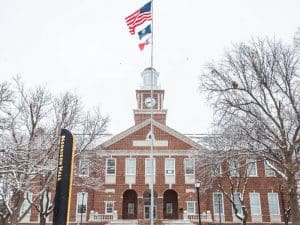
Morrison Hall on campus covered in snow.

With snow accumulation expected in Wichita Wednesday, March 5, be sure that you are prepared to stay safe as you make your way to and around campus.

  • While traveling, whether on foot or by car, allow yourself extra time to make it to your destination safely.
  • Wear warm clothing, such as water-resistant coats and boots and several layers of clothing, and cover the most-affected body parts such as nose, ears, toes, cheeks, chin and fingers with hats, scarves and gloves.
  • If you are concerned about coming to campus because of the weather, contact your supervisor about work flexibility. Students concerned about classes can reach out to their instructors.

While on campus, buildings are open during the school day, so if you feel like you are experiencing any adverse effects from the weather, take a moment to warm up in a building before continuing.

If you experience any health issues, you can contact the Faculty/Staff Acute Care Clinic in the Steve Clark YMCA on campus by calling 316-978-4792. The Faculty/Staff Acute Care Clinic can help treat minor/acute medical issues.

Morrison Hall on campus covered in snow.

With expected snow accumulation in Wichita Wednesday, March 5, be sure that you are prepared to stay safe as you make your way to and around campus.

  • While traveling, whether on foot or by car, allow yourself extra time to make it to your destination safely.
  • Wear warm clothing, such as water-resistant coats and boots and several layers of clothing, and cover the most-affected body parts such as nose, ears, toes, cheeks, chin and fingers with hats, scarves and gloves.
  • If you are concerned about coming to campus because of the weather, contact your instructors about classes.

While on campus, buildings are open during the school day, so if you feel like you are experiencing any adverse effects from the weather, take a moment to warm up in a building before continuing.

If you experience any health issues from the weather, you can contact Student Health Services (SHS) at student.health@wichita.edu or call 316-978-4792. SHS is located in the Steve Clark YMCA on campus.

In conjunction with the National Weather Service, the State of Kansas will participate in the Severe Weather Preparedness Week from March 3 to 7. At 10 a.m. Wednesday, March 5, Sedgwick County Emergency Management Services will sound the severe weather sirens throughout the county.

All personnel — faculty, staff, students and guests — are expected to go to a designated shelter until the all clear is given. This drill will be educational for all involved and provide those overseeing campus safety a way of evaluating the effectiveness of WSU’s emergency preparedness during a tornado. Go to the Wichita State tornado shelters webpage to learn more about what to do during a tornado warning and to locate your designated shelter.

For more information, contact Andrew Clem — Environmental, Health and Safety Department director — at 316-978-7904 or andrew.clem@wichita.edu.

With the low temperatures and snow accumulation in Wichita, be sure that you are prepared to stay safe as you make your way to and around campus.

  • While traveling, whether on foot or by car, allow yourself extra time to make it to your destination safely.
  • Wear warm clothing, such as water-resistant coats and boots and several layers of clothing, and cover the most-affected body parts such as nose, ears, toes, cheeks, chin and fingers with hats, scarves and gloves.
  • If you are concerned about coming to campus because of the weather, contact your supervisor about work flexibility. Students concerned about classes can reach out to their instructors.

While on campus, buildings are open during the school day, so if you feel like you are experiencing any adverse effects from the weather, take a moment to warm up in a building before continuing.

If you experience any health issues, you can contact the Faculty/Staff Acute Care Clinic in the Steve Clark YMCA on campus by calling 316-978-4792. The Faculty/Staff Acute Care Clinic can help treat minor/acute medical issues.

With the low temperatures and snow accumulation in Wichita, be sure that you are prepared to stay safe as you make your way to and around campus.

  • While traveling, whether on foot or by car, allow yourself extra time to make it to your destination safely.
  • Wear warm clothing, such as water-resistant coats and boots and several layers of clothing, and cover the most-affected body parts such as nose, ears, toes, cheeks, chin and fingers with hats, scarves and gloves.
  • If you are concerned about coming to campus because of the weather, contact your instructors about classes.

While on campus, buildings are open during the school day, so if you feel like you are experiencing any adverse effects from the weather, take a moment to warm up in a building before continuing.

If you experience any health issues from the weather, you can contact Student Health Services (SHS) at student.health@wichita.edu or call 316-978-4792. SHS is located in the Steve Clark YMCA on campus.

Morrison Hall on campus covered in snow.

Wichita State’s campus has return to normal operations today, Wednesday, Feb. 19. In-person classes will be in session.

Instructors do still have the discretion to hold their classes remotely or to cancel. Please connect with your students regarding the status of your classes. In addition, students are encouraged to reach out to their instructors for questions.

We understand it’s still snowy and very cold outside. Please be prepared for this winter weather by dressing accordingly. Students who feel they are unable to safely travel or get around on campus should connect with their instructors. Faculty or staff with similar concerns should contact their supervisor or department chair to develop an alternative plan.  

Facilities Services personnel are working hard to clear roadways and sidewalks on campus, but using caution and allowing for extra travel time is always advised when driving and walking on snow.  

Morrison Hall on campus covered in snow.

In response to the expected inclement weather, Wichita State will move to remote operations Tuesday, Feb. 18. Critical campus operations will remain open, and employees who support these operations should report to campus.

All other employees should work remotely when possible and speak with their supervisor for any specific concerns. Classes will be held remotely. Instructors are encouraged to connect with their students regarding the status of their classes, and students should reach out to their instructors for questions.

The university will resume normal operations as soon as possible, and additional updates will be shared via Shocker Alert texts, WSU email and WSU social media.

Critical campus operations that will remain open include:

  • Student housing
  • Dining options (which may reduce business hours as needed)
  • Campus police
  • Facilities services
  • Research laboratories (at faculty discretion)
  • Operations otherwise designated by the president, athletic director or any vice president