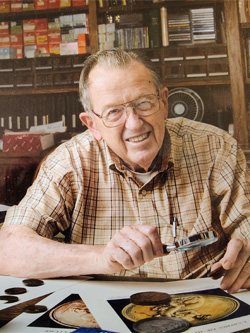
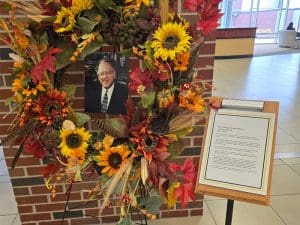
Elmer Hoyer in a tan suit and white undershirt on a beige background

Elmer Hoyer, professor emeritus of engineering, passed away March 4.

Hoyer worked for Wichita State for over 30 years before retiring in 2001, starting as an assistant professor of electrical engineering in 1966. He completed his doctoral dissertation in 1967 and was later promoted to associate professor in 1971 and professor in 1980.

Visitation will be at noon Thursday, March 12 at Old Mission Mortuary, 3424 E. 21st St. N, followed by services at 1 p.m.

Richard Todd

Richard Todd, associate professor emeritus of history, passed away Dec. 8.

Todd worked for Wichita State for over 30 years before retiring in 1996 and was honored as a Bender of Twigs in 1988. He contributed to “Introduction to the History of Christianity” and had sabbaticals in Athens and Jerusalem, where he participated in an archaeological dig.

After his retirement, Todd continued his scholarly work and published “Napoleon’s Medals: Victory to the Arts” in 2009, which shed light on the artwork depicting Napoleon’s various conquests displayed through the medals he commissioned, and later wrote the “Gold of Qumran” novel trilogy.

Services will be held at 1:30 p.m. Friday, Dec. 19 at Eastminster Presbyterian Church, 1958 N. Webb Rd.

Anna Chandler

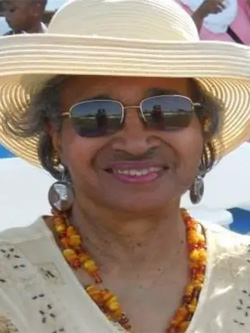
Dr. Anna Chandler, former chairperson of the ethnic studies department, died Sept. 20. Her teaching extended far beyond the classroom — she was known as a visionary educator, a captivating historian and a mentor who encouraged her students to dream beyond their own imagination.

Connie Morris

Connie Morris, retired Elliott School of Communication faculty member, passed away Feb. 4. Morris was with Wichita State for more than 35 years before retiring in 2012, but she continued to teach until 2017.

A celebration of life will be held at 2 p.m. Monday, Feb. 10 at College Hill United Methodist Church, 2930 E. 1st St. N.

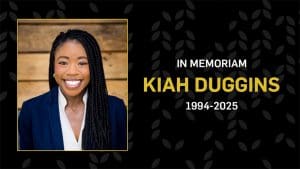
A picture of Kiah Duggins, with the text "In memoriam, Kiah Duggins, 1994-2025

We are deeply heartbroken to share with our community and friends that Kiah Duggins was aboard American Airlines Flight 5342 from Wichita to Washington, D.C.

Kiah was a proud alumna of the Barton School of Business and Fairmount College of Liberal Arts and Sciences, graduating in the spring of 2017 with degrees in international business, economics and Spanish. A recipient of the prestigious Clay Barton Scholarship in 2013, she joined a distinguished group of exceptionally talented students. During her time at Wichita State, Kiah cofounded the Shocker Food Locker, an initiative that continues to support students facing food insecurity. Her unwavering commitment to building more equitable communities is a legacy we can all carry forward within Shocker Nation.

Born and raised in Wichita, Kiah was the daughter of Dr. Maurice and Gwen Duggins, who instilled in her a deep commitment to social justice through their own dedication to serving underserved communities in education and healthcare. After graduating from Wichita State, she went on to earn her J.D. from Harvard Law School, where she served as president of the Harvard Legal Aid Bureau. It was no surprise that after law school, Kiah became an attorney with the Civil Rights Corps in Washington, D.C., continuing her family’s legacy of advocacy and service.

During her tenure as an attorney, Kiah litigated on behalf of movements challenging unconstitutional policing and money bail practices. She studied prison industrial complex abolition and movement lawyering as a Law 4 Black Lives Fellow and integrated those concepts into her daily work.

Her family remains active in the Wichita community, and this tragedy has profoundly impacted all who knew her. Today, we mourn the loss of one of our own. To those who had the privilege of knowing Kiah, our hearts are with you during this incredibly difficult time.

Kiah was a beacon of light, a testament to perseverance and an inspiration to all who dream big and work tirelessly to achieve their goals. We hope her legacy continues to inspire our students, serving as a reminder of what is possible through determination, passion and purpose.

Janet Jensen

Janet Jensen, retired senior academic advisor for the Barton School of Business, passed away on Nov. 7. Janet served as academic advisor in the Barton School for more than 20 years before her retirement in 2022. Janet is remembered warmly by her friends and coworkers, and her impact has been felt by thousands of students who she advised and guided to graduation.

Services will be held at 6 p.m. Tuesday, Nov. 12 at Culbertson-Smith Mortuary, 115 S. Seneca.

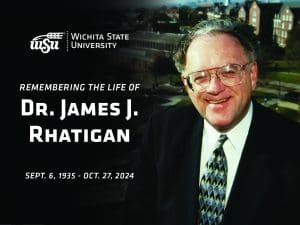
Remembering the life of Dr. James J. Rhatigan; Sept. 6, 1935-Oct. 27, 2024

Dr. James Rhatigan’s, who passed away earlier this week on Oct. 27, memorial service will be held at 1 p.m. Saturday, Nov. 2 at the University Congregational Church with a reception later that day from 2:30 to 4 p.m. at the Rhatigan Student Center.

Memorials may be made to University Congregational Church — where Rhatigan and his wife, Beverly, were charter members — and the Rhatigan Emergency Fund at WSU. The Rhatigans established the fund in the 1960s to help students in crisis.

Find the livestream of the memorial services.

Dr. James Rhatigan’s, who passed away earlier this week on Oct. 27, memorial service will be held at 1 p.m. Saturday, Nov. 2 at the University Congregational Church with a reception later that day from 2:30 to 4 p.m. at the Rhatigan Student Center.

Memorials may be made to University Congregational Church — where Rhatigan and his wife, Beverly, were charter members — and the Rhatigan Emergency Fund at WSU. The Rhatigans established the fund in the 1960s to help students in crisis.
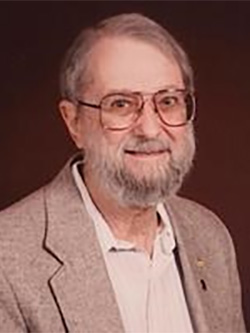
A photo of the wreath that is in the Rhatigan Student Center in remembrance of Dr. James Rhatigan

Stop by the Rhatigan Student Center information desk to view the memorial wreath in honor of Dr. James Rhatigan, professor of education and senior vice president emeritus, who recently passed away on Oct. 27.

Dr. Rhatigan came to Wichita State in 1965 as WSU’s first dean of students at just 30 years old — the youngest in the country. Six years later, he become the vice president for student affairs until 1997 when he was named senior vice president. The Rhatigan Student Center was renamed after Dr. Rhatigan in 1997 to honor his dedication to students and Wichita State.

Remembering the life of Dr. James J. Rhatigan; Sept. 6, 1935-Oct. 27, 2024

A national figure in educational activism, Dr. James J. Rhatigan, professor of education and senior vice president emeritus, died yesterday, Sunday, Oct. 27, in Wichita. Rhatigan served Wichita State for nearly six decades, arriving on campus in 1965 as the university’s first and the nation’s youngest dean of students, at just 30 years old. In 1971, he became vice president for student affairs, holding that position until 1997 and going on to serve as senior vice president until his retirement from WSU in 2002.

“Dr. Rhatigan was an exemplar of integrity, compassion and principled leadership,” WSU President Rick Muma says. “His professional commitment to excellence in higher education and his ethic of caring for those he came in contact with, most especially students, were simply unparalleled. His influence here at Wichita State won’t be forgotten.”

Recruited by then WSU President Emory Lindquist to build a “modern division of student affairs,” Rhatigan also served as Wichita State’s top student affairs administrator on the executive teams of three other presidents, Clark Ahlberg, Warren Armstrong and Eugene Hughes for a combined 32 years. His responsibilities included advising members of the Student Government Association. In 1997, the year he stepped into his new role as senior vice president, Rhatigan talked about his three decades at WSU.

“My goal,” he said, “was to do everything prudently possible to remove the obstacles, clarify the issues and ameliorate any feelings that hindered students from achieving their goals — from obtaining their education.”

For Mike James ’71, a member of the WSU Foundation and Alumni Engagement board who served as SGA president his senior year, Rhatigan was “the most influential educator I have ever known. He touched my life in multiple ways both during my time at Wichita State and after. Not only was Jim a one-of-a-kind educator, he transitioned into a most valued friend. He was simply the best.” It was James who gifted Rhatigan a small, bronze statue with an inscription that reads, in part, “The Student’s Best Friend — Always.”

Mike Meacham ’74, SGA president during the 1972-73 academic year, is among the legions of alumni who’ve learned from Rhatigan’s example.

“Jim was a guiding light for me,” Meacham wrote in a tribute to him in 2021. “I learned a lot from him — to stay open to new ideas and new thinking; understand that others’ circumstances have brought them to the place where they are in front of you; engage with others against the backdrop of producing the greatest good for the greatest number. Shine a light on a path that enables and empowers others to succeed; do that not for the ego of holding the lantern, but for the act of giving to others the possibility for self-enlightenment and growth.”

Renowned for his wit and wisdom, Rhatigan — an Iowa native who earned a bachelor’s degree in American history from Coe College, a master’s degree, also in American history, from Syracuse University and, in 1965, a doctorate in college student personnel administration from the University of Iowa — not only garnered scores of accolades and awards as a student affairs professional, he is — most appropriately — the namesake of the Rhatigan Student Center.

From 2002 until 2014, Rhatigan continued his university advocacy as a consultant for the WSU Foundation (since 2022 the WSU Foundation and Alumni Engagement). Ever the consummate professional with an eye to helping people, whatever their challenge, Rhatigan worked tirelessly and continuously throughout his tenure at Wichita State and the WSUFAE to increase access to education for tens of thousands of students, yet he never lost sight of the importance of fostering relationships on the individual level.

“I was blessed to work with Jim for close to 33 years,” says Dr. Elizabeth King, WSUFAE president and CEO emerita and former WSU vice president for university advancement. “I’m deeply saddened by the loss of my long-time colleague and dear friend. It’s impossible to capture in a few words the enormous impact he had on our university. The most frequent praise I’ve heard from alumni over the years is: ‘He was MY Dean!’ He was a tireless advocate for the needs of students and an icon nationally in the world of student affairs. He is truly one of the great ones!”

A prolific and eloquent writer, Rhatigan penned his thoughts about the term alma mater — “fostering mother” — for an address he presented in 1984. He approached the subject from a historical perspective, going back 600 years. Yet it didn’t take him long to zero in on the relational heart of the matter: “Alma mater is an anthropomorphic reference to higher education in which its creator apparently sensed and identified a phenomenon I feel is of profound importance. It implies a relationship between student and institution that is of inestimable value — deep and abiding.”

More recently, he wrote this: “Lives are changed on college campuses, this year and every year. Not every experience is positive but in their accumulation a higher education changes all of us. We know that when our life is changed others also are affected, in a growing circle of people who are integral to our life. Importantly, one never has to leave a campus because it is an idea, not merely a place. We can look backward from present circumstances that may be difficult and remember the best within us.”

Jim Rhatigan, who as recently as two weeks ago was in his campus office working, will long be remembered as one of the very best among us.

Memorials may be made to the University Congregational Church (https://ucchurch.org/), where Rhatigan and his wife, Beverly, were charter members, and the WSU Rhatigan Emergency Fund (https://fundraising.idonate.com/wichita-state-university-foundation/Rhatiganemergencyfund), which the Rhatigans set up in the 1960s to help students in crisis.