The Department of Geology is pleased to invite you to a virtual seminar featuring guest speaker Dr. Julie M. Bloxson from Stephen F. Austin State University from 3 to 4 p.m. Thursday, April 23.

Bloxson will present on “Far-field Tectonic Controls on Deposition of the Ordovician Utica/Point Pleasant Play, Ohio using Core Logging, Well Logging, and Multivariate Analysis.”

Reach out to Dr. Zelalem Demissie, associate professor of geoscience, at zelalem.demissie@wichita.edu for more information.

Speaker bio:

Bloxson is an associate professor in the Department of Earth Sciences & Geologic Resources at Stephen F. Austin State University. Her research focuses on Gulf Coast, East Texas and Appalachian Basin systems, with emphasis on petroleum systems, stratigraphy, critical minerals in brines, geothermal resources and salt tectonics.

She leads student-driven research on subsurface systems using an integrated framework that combines field geology, petrophysics, geochemistry and geospatial analysis. Prior to her academic appointment, she worked with the Ohio Division of Geological Survey on CCUS reservoir characterization, salt studies and subsurface analysis.

Bloxson earned her doctorate in earth sciences from Case Western Reserve University, where she investigated mineralogy and facies distribution of the Utica Shale. She holds an master’s in geology from Kent State University (CCUS-focused research on Clinton Sands) and a bachelor’s in geology from the University of Akron.

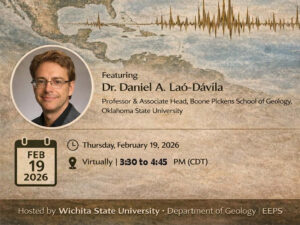
Featuring Dr. Daniel A. Lao-Davila

You are invited to the upcoming EEPS 700 Graduate Seminar featuring Dr. Daniel A. Laó-Dávila, professor and associate head of the Boone Pickens School of Geology at Oklahoma State University, from 3:30 to 4:45 p.m. Thursday, Feb. 19 virtually via Zoom.

Dr. Laó-Dávila will present: “Segmentation, Linkage, and Propagation of the Isla de Mona Fault: Earthquake Processes Along the Caribbean – North America Plate Boundary.”

This lecture will explore how fault segmentation and structural linkage govern earthquake rupture behavior and seismic hazard along active plate boundaries. The seminar will be particularly relevant for scholars and students working in structural geology, tectonics, seismic hazard and plate-boundary processes.

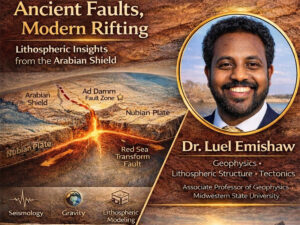
A photo of Luel Emishaw with an illustration of the fault lines in the Middle East

You are invited to an upcoming EEPS 700 Graduate Seminar, hosted by the Department of Geology, featuring Dr. Luel Emishaw, associate professor of geophysics at Midwestern State University, from 10 to 11 a.m. Friday, Feb. 13 via Zoom. Registration is required.

Dr. Emishaw will present “Lithospheric Structure of the Neoproterozoic Ad Damm and Fatima Fault Zone, Arabian Shield: Implications for the On-Land Continuation of a Red Sea Transform Fault,” highlighting insights into lithospheric architecture, continental rifting and Red Sea tectonics.

This virtual seminar is open to graduate students, researchers and professionals across Earth, environmental and physical sciences.

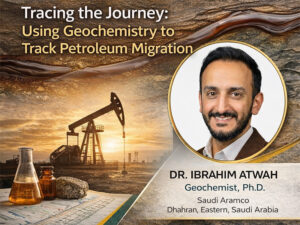
Tracing the Journey: Using Geochemistry to Track Petroleum Migration with Dr. Ibrahim Atwah, geochemist, with an oil rig in the background and flasks with various liquids in the foreground

You are invited to attend the upcoming EEPS 700 Graduate Seminar from the Department of Geology featuring Dr. Ibrahim Atwah, geochemist at Saudi Aramco, from 10 to 11 a.m. Friday, Feb. 6 via Zoom.

Atwah will discuss how geochemical tools are used to reconstruct petroleum generation and migration pathways in “Tracing the Journey: Using Geochemistry to Track Petroleum Migration,” offering insights that help reduce uncertainty in petroleum system analysis.

Atwah serves as the focus area champion for geofluids and basin modeling at Saudi Aramco’s EXPEC Advanced Research Center. He holds a Ph.D. from Texas A&M University and brings over 15 years of experience in petroleum exploration, geochemistry and basin modeling. He has published more than 20 peer‑reviewed papers, holds multiple patents and serves as an associate editor for Petroleum Science and Technology.